Housing, Home and Content(s)
Master Studio 26, University of Melbourne
Individual work | semester 1, 2020
Studio Leader: Colby Vexler; Pricilla Heung
It’s not that I don’t believe in the signs and symbols of domestic occupation…it’s just that I don’t believe they bear the slightest message of such domestic anticipation or actualisation, and it is in that respect they are truly signifying.


House and Home for:
The Domestic
Contemporary domesticity is the relentless process of rebuilding and restaging one’s collection to display ownership, aesthetic, status, etc. The state of Inhabiting has become secondary when excessive decoration and stylish fashion dominate space. The dwindling inhabitation of domestic space simplifies itself into nothing but an ever-growing container of collection.
To resurrect the state of occupying. Domestic needs to get away from over-saturated information of signs, symbols from the outside. Simulacra reflect on the excessive desire and implosion of redundant information in consumer culture. The simulacra domestic is a nostalgic and melancholic existence where hype-real precedes the territory of reality. It reimagined domestic space being covered by a singular, malleable coating. The malleable surface facilitates inhabitants to rebuild and restage objects as well as invites them to occupy and to be exhibited within the domestic. It attempts to capture the temporal contingency through dynamic interaction and movement.
Such disappearance of conventional domestic elements has shifted attention from collection to the spatial quality, and facilitates reflection on constantly changing curatorial relationships between objects and subjects.
Preface: A House and Home
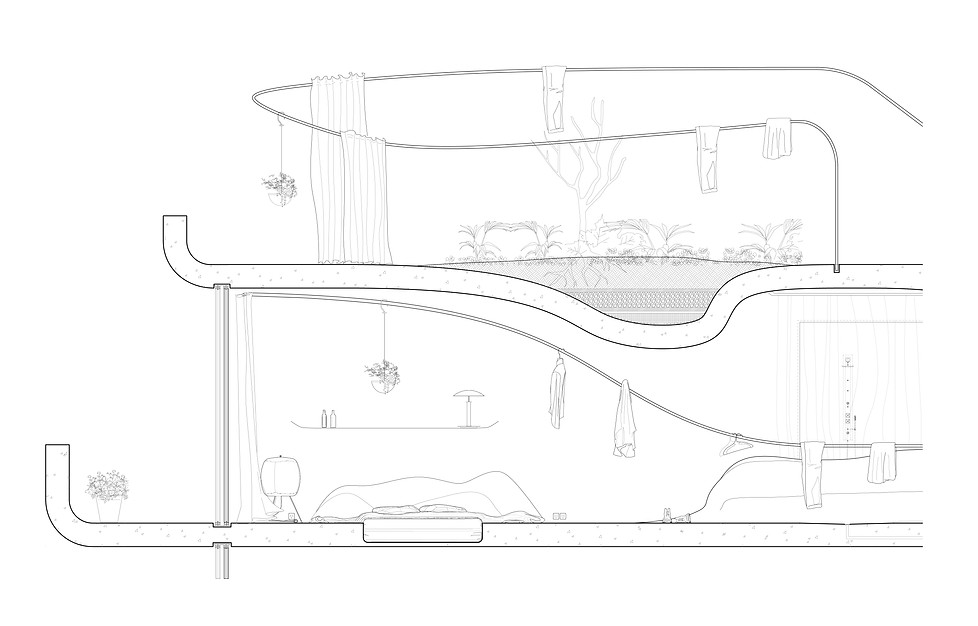


Static moment is abrupt by the dynamic movement of curtains, The center of domesticity has no absolute boundary, and is subject to merge with other space.
A surface acts as an agent mediates between internal and external. Uncertainty and ambiguity take place in the liminal space.
Overtime, the surface has less and less to do with the division of space, rather the proliferation of display opportunities. The interior became a topology of exposition where every single trace of domestic life became displayed.
The house will augment the relationship between: Where architecture may be at home in - and provides a home for - an exploration around: the real, ideal, fetishised, and/or romanticised contemporary life.
The house produced will act as an agent for mediating, critiquing and navigating the limitations, possibilities and transferences between the conceptual and material, revealing the unexpected, through the slippages, transitions and tension between ideas, content(s), user and space. Here, the use of materiality, program, tectonics, scale and junctions between the site of ideas and objects of content(s) will be explored.
Projects will focus on the transference and meditation the home may play between the contextual and the material via three moments of the student’s choice. Here, students will explore the moments and their in-betweens with successful projects revealing the unexpected, through the slippages, transitions and tension between ideas, content(s), user and space. Successful projects will also develop a critical position on what “House” means, “Home” means and what it is to be at “Home in” and at “Home for.”
The home may become a critical survey, experiment or meditation.
Selected Drawings from the project:
Thickened surfaces of the walls permit the house to consume and to display. Every gesture becomes part of display, intended or unintended, restaging and rebuilding domesticity in an inconsistent and unpredictable way.
CONTEXT, FRAME AND SITE
In the early stages of the studio, students will be assigned a precedent concept, exploring this precedent via the web, print and various other sources, collating and filtering information regarding this project into a presentation as model, image and text.
This material will act as a brief; a plan, representing a place, to frame and materialise their set of thoughts around the domestic condition, establishing relationships between their respective ideas; its users, content and space, a contextual container that houses the content(s) and design to come.
This brief will establish a critical and abstract site for the rest of the semester - the students will begin to develop ideas around entry, edge, transition and statis via the use of planes, fields, sequence, surface, spans, voids, frameworks etc.


A comprehensive journal document:
