Relish
Progressive Web App for Restaurant Recommendation
Group Project | 2024
Team: Nick Ng, Nobu Funahashi, Yichen Cao (Front-end, Design)
View our Code Repository


Project Brief
The Relish app is designed to cater to the needs of foodies and explorers who are always on the lookout for new dining experiences.
Research + Problem Statement
Overall, this app provides a valuable service to its target audience. Our app will be tailored for someone who is always excited to try new things and has a bit of 'collector' persona in that case. We identified the current restaurant searching app on the market (i.e. Google Map - Restaurants) has a gap where user cannot only filter the restaurant they have never been to.
Solution
After identifying the problems and limitation, we thought we could integrate and improve the recommending and filtering features into our product. For example, we implement Quiz feature for users to select what they prefer the first time they use the app.
This feature will help our app better understand what our user preferences are and narrow down the recommending lists fetched from API. Along side that feature, we also add a Feeling Hungry? button to generate 10-20 suggestions for same cuisine or dish. (In case the users find it hard to decide!)
Overall, the search and recommendation features make it easy for users to discover new restaurants in their area. The UI design is integrated to be user-friendly and intuitive, ensuring that users can easily navigate the app and find what they need.

Discover Where and What to Eat with Ease
Where to Eat lets you explore dining options by entering a location or simply enabling access to your current location. By default, we’ve set it to Melbourne CBD for quick and convenient searches.
What to Eat helps you find the perfect dish or cuisine—just type in your favorite and receive tailored restaurant recommendations. Unsure of what to eat? Try your luck with our Feeling Hungry? button for spontaneous suggestions!
Have I Been There? allows you to track restaurants you’ve visited, automatically removing them from future recommendations. You can always revisit your saved spots in your profile.
Book a Table feature streamlines your reservation experience, offering quick access to details like phone numbers and Yelp reviews to help you make informed choices with a single click.

You can track your Milestones and earn Relish Awards to make every visit a memorable experience. When the award is not achieved we design the mystery card for you to take a guess. It just adds so much more fun. You can always view newly added awards in your profile and we will celebrate every moment when you unlock a new award.
Live Demo
Imagine we’re in Collingwood, and it’s time to eat! We open Relish and with a single tap on "Sign in with Google", we’re in—no passwords needed. Relish instantly picks up our location, so we’re ready to search. Let’s say we’re craving Pad Thai. Typing it in brings up suggestions immediately, or we can tap from popular cuisine options like Japanese.
Within seconds, Relish shows us top-rated Japanese spots nearby, complete with photos, reviews, and travel distances. We can even see the map to find the closest options.
After trying a new place, we mark it as visited, so it’s removed from future searches. Our profile then updates with awards for our dining adventures and keeps a log of all the places we’ve tried for easy revisits. Relish makes exploring and tracking our foodie journey effortless!

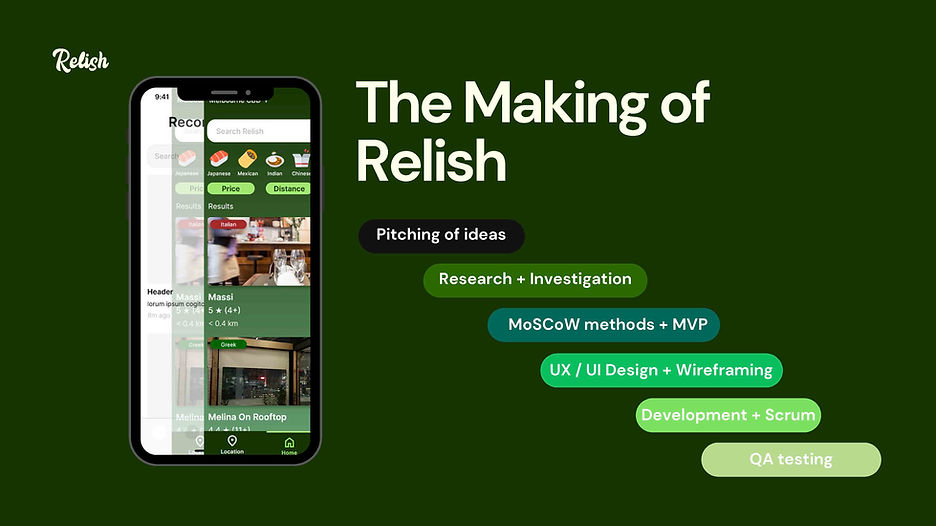
The Journey of Building Relish
Creating Relish has been a detailed, iterative process, outlined in our Product Roadmap. We began with in-depth research to identify gaps in the restaurant app market, aiming to develop an app that truly stands out. Throughout the process, tools like Miro, Slack, and Trello helped us brainstorm, coordinate, and track our progress from initial concepts through to the final product.
To define our Minimum Viable Product (MVP), we employed the MoSCoW prioritization method, focusing on the essential features like Where to Eat, What to Eat, and Have I Been There. This approach helped us deliver a fully functional MVP within a tight timeline, with additional features like an award system added later to enhance user engagement.
To manage development, we adopted the Scrum methodology, running regular sprint planning sessions, daily standups, sprint reviews, retrospectives, and backlog refinements. Although challenging at first, this agile approach allowed us to collaborate effectively, address issues as they arose, and stay flexible to changes.
As we approach launch, we continue to iterate based on user feedback, testing on various devices and browsers, and resolving bugs to ensure a seamless experience.

Reflection and what’s next?
Overall, we aimed to address some significant pain points in restaurant searching app among current market competitors, which is to encourage users to explore new restaurants and help decision making on what to eat to foster communication and reviews among small business in local community.